

I'm a rabid chaser of Flow (mostly of the creative/artistic or nature-immersing varieties. I'm not a big wall rock climber or big wave surfer 😅).
And I’m a NERD for devoting time to regular learning and immersing into all things Flow — the neuroscience of it, and learning about peoples’ Flow habits and practices.
And, I’m deeply curious about our relationships with Place. I think that comes from not always feeling emotionally safe growing up, and I now I overcompensate by looking for belonging and this Place-relationship-stories curiosity.
Flow is a big, broad topic, but I wanted to dive into a short discussion about the kindred relationship between Place/Setting and Flow—because—I’ve learned that ‘setting’ is more than you think when it comes to optimal Flow conditions.
What is Flow?
This is a basic you might already know (or have Googled), but Steven Kotler and the Flow Research Collective (building on the work of Mihaly Csikszentmihalyi, who first coined Flow and Flow States as terms) define Flow as:
“[Flow is]…a highly focused and immersive mental state in which an individual's skill level matches the challenge of the task, resulting in reduced self-awareness, altered time perception, and heightened positive emotions.”
My partner, Ixchel Lunar, often refers to to Flow as our Birthright, our natural default state. I love that as an even deeper, embodied definition that’s less “productivity” and “output” focused (as tends to be the case with a lot of folks who write about Flow).
Many of us have forgotten or disassociated with that at a base level. At a body level. Or we fall in and out of remembering that natural state.
Many factors impact our ability to get into Flow regularly. There are the Flow Activators themselves (an estimated 13 individual activators and 9 additional Group Flow activators, mas o menos). But there are also ingredients like Passion, Purpose, Motivation, and the activities we choose to focuus on in the mix.
Our environment — our Setting — is one of those vital ingredients that impacts our dance with Flow.
Setting is Our Physical Spaces
Our physical spaces where we do our deepest, most immersive creative, and impactful work are wildly important. It's vital for us to design and find spaces with fewer distractions, that reduce cognitive load during the day
That isn—the sacred spaces of solitude or group collaboration we create in our homes or offices to hold space for Deep Work.
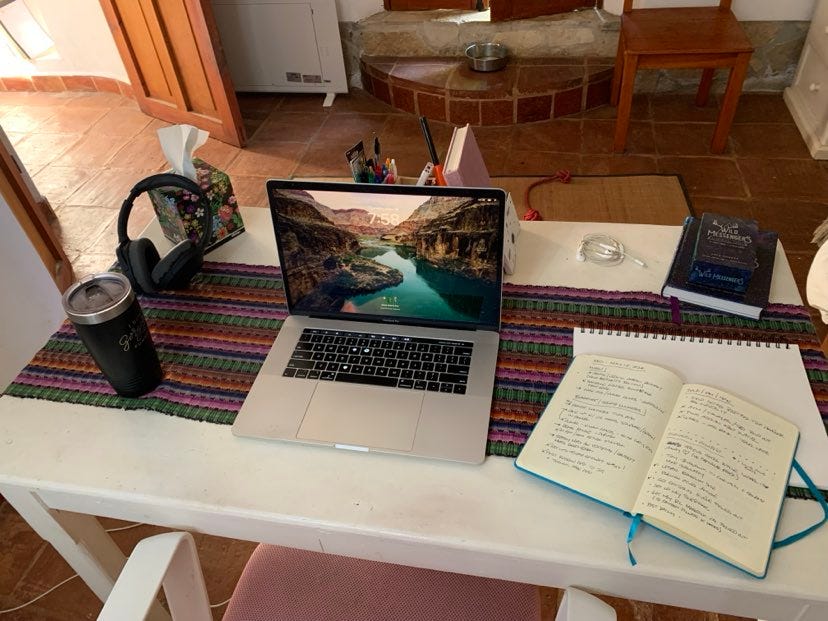
I’m a 100% remote-working freelancer and team leader. So I have a couple of these spaces in our home in Chiapas, Mexico. One is my dedicated office space. My desk is a blend of “having all the things on it that fuel my work and bring me joy” and “only the essential things” that keep me focused.
The other is my favorite sit spot, tucked behind our kitchen. It faces a big picture window looking out on an empty lot behind our house, which the community uses for growing food. It’s here that I sometimes do work-related, laptop-bound Flow work, but also use it as a place for just ideating or fun, non-work flowy things like coloring.
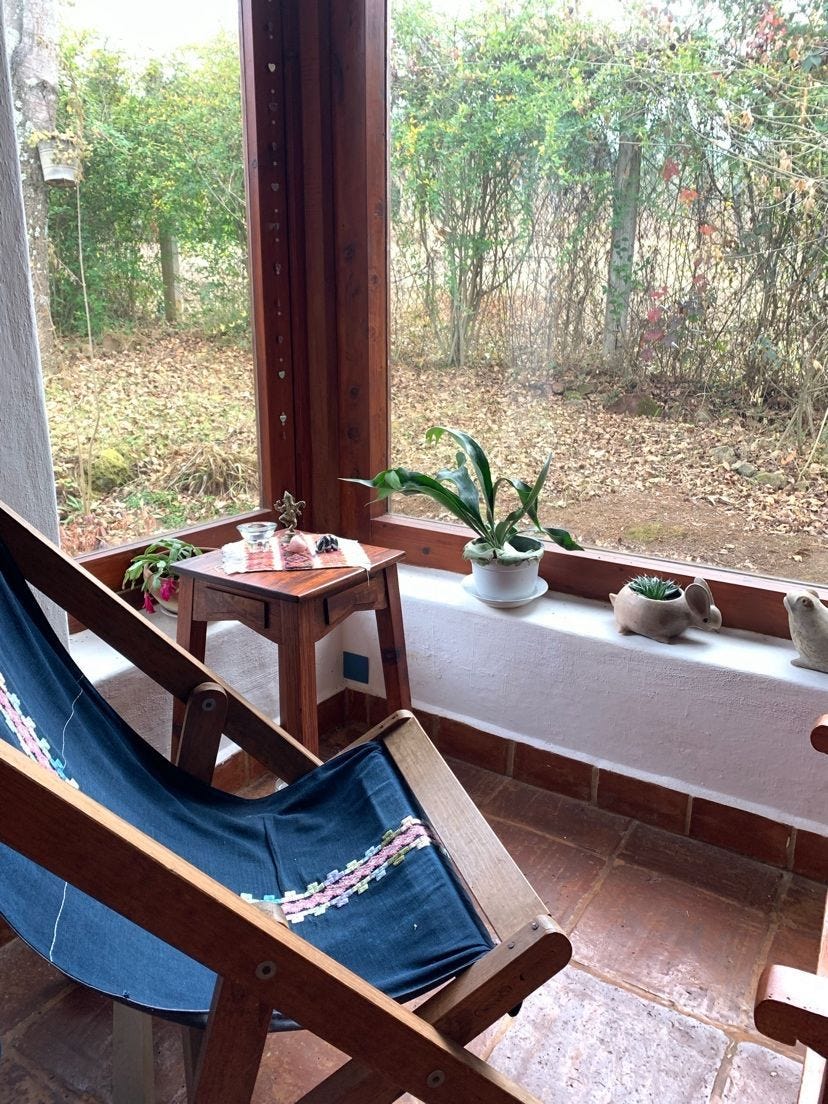
Your physical space could be this, but also could be jamming in a co-working space or a cafe you love, maybe with headphones on to block out noise. We each have the Flow habits and practices that work for us individually.
Working beyond the physical “room,” I've come to learn/love that the "setting" that supports us in chasing Flow is more than just physical spaces like these.
Setting is Somatic
Beyond the physical room, our bodies are also the “setting” in which we work. A pretty important one. A healthy, embodied relationship with our human meat sack and our nervous system is vital to our connection to Flow.
So that’s how well we're caring for ourselves with good food, hydration, and sleep habits. But it's also how well we're supporting our nervous systems, emotional health, and body trust.
While most Flow proponents or experts will tell you the Flow Cycle starts with leaning into the struggle phase that precedes Flow, Ixchel will tell you that it needs to start with Rest.
Without Rest, our nervous systems can be put on edge, which creates distrust within our bodies. Which can prevent us from accessing Flow, because our bodies don’t trust us to go there
(Ixchel expounds upon this and many more Flowy things in an awesome, recent interview on Megan Leatherman’s ‘A Wild Thing’ podcast. You should check it out.)
I continue to practice on creating from a place of excited but emotionally neutral, which gives me both the Dopamine and the focus and centeredness that I need for Flow. With Ixchel’s help I have a daily/weekly body check routine going that helps a lot with keeping focus on things that matter and working from Purpose.
Setting is Motivation and Semantics
Intrinsic motivation is a key ingredient for Flow. Meaning, the things we’re choosing to focus and work on are the things we feel the internal pull to do — for the joy and curiosity of it — as opposed to doing them only for external reasons like money.
So, for me, that set point is another technicolor coat that “setting” wears. Find the things that fuel your Purpose and drive your contributions to the collective (however you define that — your family, your place of work, your immediate community, or something more global).
Related, our words and intent are kindred partners with our Motivation. It's "Right Speech" in the Buddhist tradition. How we speak to ourselves. How we describe our work and Purpose. How we collaborate with others. Doing that from a place of intrinsic motivation is the bedrock for consistent Flow.
I deal with negative self-talk all the time. You might as well. I’m a people-loving-socially-awkward-introvert, so—for me it’s a want to serve and be seen walking in step with a fear to actually be seen. Even though I know I’d have fun getting up on video regularly, or launching a new podcast — so far my my creative work has only manifesting as written pieces like this, where I don’t have to show my face.
It’s the container where I can find both safety and Flow right now. I’m working on it, as we all should, because the world needs us and the unique things we bring to the party.
All that to say that where we focus our attention, manifests, and if we focus on fear and negative self talk, that can affect our motivation, which can limit our Flow.
Setting is Our Relationship With Time
Time is Place, and vice versa. It’s not a physical ‘setting’ like your favorite chair or cafe, but but our relationship with Time is a necessary container and condition for Flow.
The most mainstream manifestation of this is in the form of things like time blocking, which you’re probably familiar with, or even practice.
And I do that. I time block like crazy in my Google Calendar, sometimes excessively. Blocks for client work, for creative work, for business development, for personal/family/Hedonic time. I’m learning to leave liminal spaces between those colorful time blocks on my calendar to allow for things to be fluid.
But this is an invitation to go even deeper, as Ixchel and other decolonial leaders might teach us. It’s an invitation to really get to know our specific, personal rhythms that might not jive naturally with the normative M-F/9-5.
So that’s diving feet first into (re)aligning our good, vital work with our natural body rhythms — and the larger seasonal, natural, and cosmic rhythms. Another h/t to Ixchel who is a brilliant mentor and coach on this topic. They have a bevy of resources at decolonizingtime.com and through their Dragon Letters newsletter. You should check those out.
Start with noticing and witnessing when your peak energy times are in a given day. Focus on nutrition, hydration, rest and recovery, and good sleep — and how those impact your daily energy and focus. You are your most important laboratory!
Expand that awareness into getting to know your surroundings, nature (or what passes for nature where you live), and your relationship with the seasonal cycles (Ixchel’s Time Devotion Renewal Kit is a great resource for this).
I’m an event planner and a project manager. I LOVE structure and a good Asana plan. And, we all operate in the same capitalist structures. Goal setting. Quarterly and Weekly milestones. Today’s throughput.
And I operate in that system, but I’ve also learned to imagine and plan and track goals to a more seasonal, lunar, non-Gregorian “schedule.” It’s massively helpful in keeping me grounded in a greater Purpose of service, which helps drive motivation, which begets more focus and Flow.
The physical spaces we create for doing our work definitely impact our ability to dive deep and lose ourselves in deep thought or creative Flow. But I’ve found these other ‘setting’ ingredients to also be super important.
It’s finding/designing physical spaces that bring us joy and support our focus.
It’s our relationship with our bodies and finding set points of emotional and psychological safety on the regular.
It’s how deeply rooted we are in our unique Purpose and gifts to motivate us down whatever individual and collective path we’re on.
It’s the language and words we use — with ourselves and with others —that affect our motivation.
And it’s our relationship with Time — the work we do to (re)discover our own unique rhythms, amplify those with a deeper connection to the natural and cosmic rhythms, and use those things to drive more focused, more meaningful work, more consistently.
It’s a fun cocktail to play with!
What about you? What manifestations of ‘Place’ are most important to your own focus, Flow, and creative work? Drop a comment below or hit reply to send me a note.
If you’re looking for help rejiggering your purpose, focus, and Flow, definitely hit up Ixchel at decolonizingtime.com. If you’re looking for project, operations, or remote workforce advice or help, I’m your guy! Send me a note or book a time at bearfuht.com for us to chat!